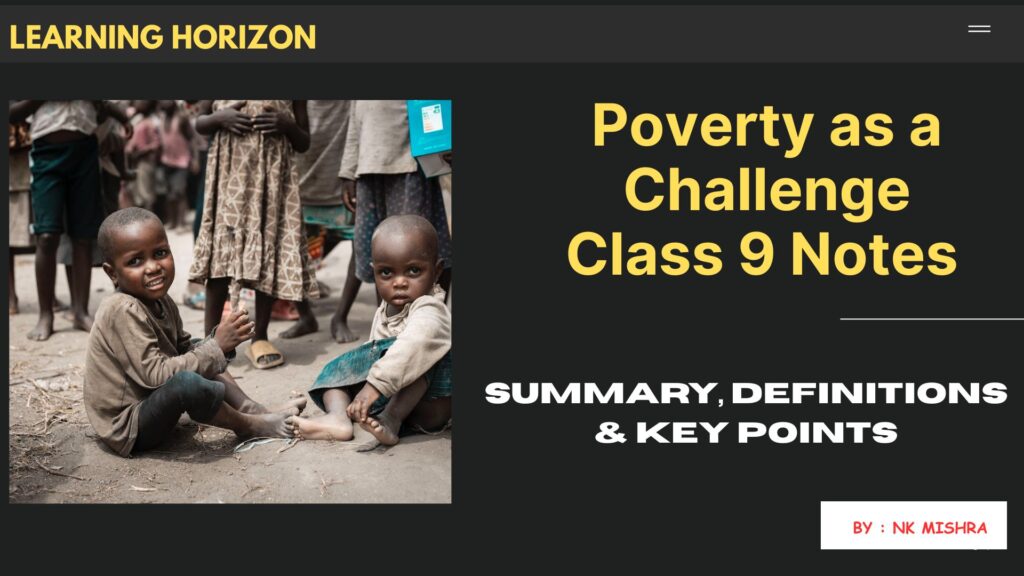
Poverty as a Challenge Class 9 Notes | Summary, Definitions & Key Points
Poverty as a Challenge is an important chapter of Class 9 Economics that explains the meaning of poverty, how it is measured, and why it remains a major challenge for India. These notes provide a simple and clear understanding of key concepts such as poverty line, causes of poverty, vulnerable groups, rural and urban poverty, and the steps taken by the government to reduce poverty. With easy explanations, examples, and important points, these Class 9 Poverty as a Challenge Notes help students prepare quickly for exams and understand the chapter in a better way.
Read Also : Chapter 1: Resources and Development CLASS 10TH
1. Meaning of Poverty
- Poverty refers to a situation in which a person is unable to meet basic needs like food, clothing, housing, education and health care.
- A poor person lacks proper shelter, sanitation, clean water, and regular income.
2. Poverty Line
- Poverty line is a minimum level of income needed to satisfy basic needs.
- In India, it is measured on the basis of calorie intake:
- 2400 calories/day for rural areas
- 2100 calories/day for urban areas
- Based on this, the government fixes a per capita monthly income as Poverty Line.
3. Social Indicators of Poverty
Poverty is also measured using social indicators like:
- Illiteracy
- Lack of sanitation
- Malnutrition
- Child labour
- Low access to health facilities
- High infant mortality rate
Read Also : Physical feature of india
4. Who are the Most Vulnerable?
Groups more likely to be poor:
- Scheduled Castes (SCs)
- Scheduled Tribes (STs)
- Rural agricultural labourers
- Casual labourers
- Urban daily wage workers
5. Causes of Poverty
Major causes include:
- Low level of economic development
- Unemployment and underemployment
- Unequal distribution of land and resources
- Rapid population growth
- Lack of education and skills
- Social discrimination
- Backwardness in health and infrastructure
6. Global Poverty Trends
- Poverty has declined worldwide, especially in China and Southeast Asia.
- In South Asia (India, Pakistan, Bangladesh) and sub-Saharan Africa, poverty remains high.
Poverty as a Challenge Class 9 Notes | Summary, Definitions & Key Points
7. Features of Poverty in India
- Poor people live in kutcha houses.
- Lack of clean water, electricity, healthcare, and education.
- High dependence on agriculture and irregular employment.
- Low wages and constant debt.
8. Anti-Poverty Measures in India
A. Economic Growth
- Higher economic growth creates employment and reduces poverty.
B. Targeted Anti-Poverty Programmes
Important government schemes:
- MNREGA – Provides 100 days of guaranteed wage employment.
- PM Rozgar Yojana – Employment for educated unemployed youth.
- PM Garib Kalyan Anna Yojana – Free food grains.
- National Food for Work Programme – Employment in rural areas.
- SGSY → NRLM – Self-help groups (SHGs) for poor women.
C. Improving Human Development
- Education
- Health
- Skill development
- Safe drinking water
- Housing
Poverty as a Challenge Class 9 Notes | Summary, Definitions & Key Points
9. Poverty Estimates in India
- Poverty has steadily declined since 1973–74.
- Economic reforms and government schemes have helped reduce poverty levels.
10. Ways to Reduce Poverty
- Create more jobs
- Improve education
- Empower women
- Provide skill training
- Improve agricultural productivity
- Control population
- Strengthen anti-poverty schemes