Most important NCERT physics questions: class12th best Q & A for 2026 board exam
Most important NCERT physics questions
Topic 1
Q1. Why do we see sparks or hear crackling sounds while removing synthetic clothes in dry weather?
Answer:
When synthetic clothes rub against our body, electric charges accumulate due to friction. In dry weather, the charges do not leak away easily. When the clothes are removed, these charges suddenly discharge through air or our body, producing sparks or crackling sounds.
Q2. What is static electricity?
Answer:
Static electricity refers to the electric charges at rest that accumulate on the surface of bodies due to friction or rubbing.
Q3. What is electrostatics?
Answer:
Electrostatics is the branch of physics that deals with the study of forces, electric fields, and electric potentials produced by stationary (static) electric charges.
Q4. Who discovered that rubbed amber attracts light objects?
Answer:
This phenomenon was discovered by Thales of Miletus around 600 BC.
Q5. How did the term “electricity” originate?
Answer:
The word electricity comes from the Greek word “elektron”, which means amber.
Q6. What observations led to the conclusion that there are two kinds of electric charges?
Answer:
Experiments showed that:
- Two glass rods rubbed with silk repel each other.
- Two plastic rods rubbed with fur repel each other.
- A glass rod attracts a plastic rod.
These observations proved the existence of two different kinds of electric charges.
Q7. State the basic laws of electric charges.
Answer:
- Like charges repel each other
- Unlike charges attract each other
Q8. What is meant by polarity of charge?
Answer:
The property that distinguishes the two types of electric charges is called the polarity of charge.
Q9. What happens when a glass rod rubbed with silk is brought into contact with the silk again?
Answer:
The attraction disappears because the opposite charges neutralise each other, making both objects electrically neutral.
Q10. Why are electric charges called positive and negative?
Answer:
Benjamin Franklin named the two types of electric charges as positive and negative based on their neutralising behavior.
Q11. What is the conventional sign of charge on a glass rod and silk?
Answer:
- Glass rod → Positive charge
- Silk cloth → Negative charge
Q12. What does it mean when a body is electrically neutral?
Answer:
A body is electrically neutral when the total positive charge equals the total negative charge, resulting in zero net charge.
Q13. What is a gold-leaf electroscope?
Answer:
A gold-leaf electroscope is a device used to detect the presence and relative amount of electric charge on a body.
Q14. Why do the gold leaves diverge when a charged body touches the electroscope?
Answer:
When charge flows onto the leaves, both acquire the same type of charge, causing them to repel each other and diverge.
Q15. Why are material bodies normally electrically neutral?
Answer:
Because they contain equal amounts of positive and negative charges, which balance each other.
Q16. Why is electric force described as all-pervasive?
Answer:
Because forces holding atoms, molecules, solids together, adhesive forces, and surface tension are all electrical in nature.
Q17. How can a neutral body be electrified?
Answer:
A neutral body can be electrified by adding or removing electrons.
Q18. Which charged particles are transferred during charging of solids and why?
Answer:
Only electrons are transferred because they are loosely bound to the atom compared to protons.
Q19. How does a body acquire positive or negative charge?
Answer:
- Positive charge → loss of electrons
- Negative charge → gain of electrons
Q20. Is new electric charge created during rubbing? Explain.
Answer:
No new charge is created. Electric charge is conserved; only a small number of electrons are transferred from one body to another.
Topic 2
Q1. What is a conductor?
Answer:
A conductor is a substance that allows electric charges (electrons) to move freely through it and hence permits the easy flow of electricity.
Q2. Give examples of conductors mentioned in the text.
Answer:
Examples of conductors are:
- Metals
- Human and animal bodies
- Earth
Q3. Why do conductors allow electricity to pass through them easily?
Answer:
Because they contain free electrons that can move easily inside the material.
Q4. What is an insulator?
Answer:
An insulator is a substance that does not allow electric charges to move freely, thereby offering high resistance to the flow of electricity.
Q5. Give examples of insulators from the text.
Answer:
Examples of insulators include:
- Glass
- Porcelain
- Plastic
- Nylon
- Wood
Q6. Why does a metal spoon not retain charge when rubbed?
Answer:
Because metal is a conductor and the charge leaks through our body to the ground, as both the human body and Earth are conductors.
Q7. Why does a metal rod with a wooden or plastic handle show charging when rubbed?
Answer:
Because the wooden or plastic handle is an insulator, it prevents the charge from leaking through the hand to the ground, allowing the metal rod to retain charge.
Q8. Why does a nylon or plastic comb get electrified when combing dry hair?
Answer:
Because nylon and plastic are insulators, so the charges produced by rubbing remain on the surface and do not flow away.
Q9. Why does a metal article generally not get electrified by rubbing?
Answer:
Because in metals, being conductors, the charges flow away easily through the body and the ground.
Q10. What happens to charge transferred to a conductor?
Most important NCERT physics questions: class12th best Q & A for 2026 board exam
Answer:
When charge is transferred to a conductor, it spreads over the entire surface of the conductor.
Q11. What happens when charge is given to an insulator?
Answer:
The charge remains localized at the place where it is put and does not spread over the surface.
Q12. Why is there a difference in charge distribution between conductors and insulators?
Answer:
Because conductors have free-moving electrons, while insulators do not allow free movement of charges.
Q13. What is meant by a point charge?
Answer:
A charged body whose size is very small compared to the distance between interacting bodies is treated as a point charge, with all its charge assumed to be concentrated at a single point.
Q14. Why are charged bodies sometimes treated as point charges?
Answer:
To simplify calculations, when the size of the body is negligible compared to the distance between them.
Q15. What basic property of electric charge is highlighted in this section?
Answer:
That electric charge exists in two types (positive and negative) and that their effects tend to cancel each other.
Topic 3 : Additivity of Charges
Q1. What is meant by the additivity of electric charges?
Answer:
Additivity of charges means that the total charge of a system is equal to the algebraic sum of all individual charges present in the system.
Q2. How is the total charge of a system of two point charges calculated?
Answer:
If the system contains two point charges q1 and q2, the total charge is: Q=q1+q2
Q3. Write the expression for the total charge of a system containing n charges.
Answer:
If a system contains n charges q1,q2,q3,…,qn, then the total charge is: Q=q1+q2+q3+…+qn
Q4. Why is electric charge called a scalar quantity?
Answer:
Electric charge has magnitude only and no direction, therefore it is a scalar quantity, similar to mass.
Q5. How is electric charge similar to mass?
Answer:
Both electric charge and mass are scalar quantities and follow additive property, i.e., they add algebraically.
Q6. State one important difference between mass and electric charge.
Answer:
Mass is always positive, whereas electric charge can be positive or negative.
Q7. Why must proper signs be used while adding charges?
Answer:
Because electric charges can be positive or negative, their signs affect the algebraic sum and hence the net charge of the system.
Q8. Calculate the net charge of a system having charges +1, +2, –3, +4 and –5 units.
Answer: (+1)+(+2)+(−3)+(+4)+(−5)=−1
So, the net charge is –1 unit.
Q9. Does the distribution or position of charges affect the total charge of a system?
Answer:
No. The total charge depends only on the algebraic sum of individual charges and not on their positions.
Q10. Can the net charge of a system be zero even if charges are present?
Answer:
Yes. If the sum of positive charges equals the sum of negative charges, the net charge becomes zero.
Topic 4 : Quantization of Charge
Q1. What is meant by quantization of electric charge?
Answer:
Quantisation of charge means that electric charge exists in discrete packets and the charge on any body is always an integral multiple of a fundamental charge e.
Q2. Write the mathematical expression for quantisation of charge.
Answer: q=ne
where n is an integer (positive or negative) and e is the elementary charge.
Q3. What is the value of the elementary charge?
Answer: e=1.602×10⁻¹⁹ C
Q4. What is the charge on an electron and a proton?
Answer:
- Charge on electron = –e
- Charge on proton = +e
Q5. Why is electric charge considered a discrete quantity?
Answer:
Because charge can increase or decrease only in integral multiples of e, not in arbitrary fractional amounts.
Q6. Why does electric charge appear continuous at the macroscopic level?
Answer:
At the macroscopic level, charges involved are very large compared to e. The step size e is extremely small, so charge appears continuous.
Q7. Why is quantisation of charge important at the microscopic level?
Answer:
At the microscopic level, charges are of the order of a few electrons, so they appear in discrete units and quantisation cannot be ignored.
Q8. How many electrons make up a charge of –1 C?
Answer: Number of electrons≈6×10¹⁸
Q9. Who first suggested and experimentally verified the quantization of charge?
Answer:
- Suggested by Faraday (from laws of electrolysis)
- Experimentally verified by Millikan (1912)
Q10. What is the SI unit of electric charge?
Answer:
The SI unit of electric charge is the coulomb (C).
Q11. Define one coulomb in terms of electric current.
Answer:
One coulomb is the charge flowing through a conductor in 1 second when the current is 1 ampere.
Q12. Why are smaller units of charge used in electrostatics?
Answer:
Because charges of magnitude 1 C are very large, so smaller units like mC and µC are more convenient.
Q13. Express the charge on a body having n1 electrons and n2 protons.
Answer: q=(n2−n1)e
Q14. Why must the charge on a body always be an integral multiple of e?
Answer:
Because both n1and n2 are integers, their difference is also an integer, making charge always a multiple of e.
Q15. Why is quantization of charge not noticeable in daily life?
Answer:
Because the elementary charge is extremely small, and we deal with charges much larger than e.
Q16. Explain the dotted line analogy used for quantization of charge.
Answer:
Just like a dotted line appears continuous from a distance, a large number of tiny charges appear as a continuous charge distribution, even though they are discrete.
Most important NCERT physics questions:
TOPIC 5
Q1. What is Coulomb’s law?
Answer:
Coulomb’s law states that the electrostatic force between two point charges is:
- Directly proportional to the product of the magnitudes of the charges, and
- Inversely proportional to the square of the distance between them,
and the force acts along the line joining the two charges.
Q2. Write the mathematical form of Coulomb’s law (scalar form).
Answer: F=kq1q2/r2
where
q1,q2 = charges,
r= distance between them,
k = Coulomb’s constant.
Q3. What is the value of Coulomb’s constant kkk in SI units?
Answer: k=9×10⁹ N m2C−2
Q4. Why are charged bodies treated as point charges in Coulomb’s law?
Answer:
When the size of charged bodies is very small compared to the distance between them, their size can be ignored and they can be treated as point charges.
Q5. How did Coulomb experimentally verify his law?
Answer:
Coulomb used a torsion balance to measure the force between two charged metallic spheres by varying:
- The distance between charges
- The magnitude of charges
and established the inverse square law.
Q6. How did Coulomb vary the magnitude of charge during experiments?
Answer:
By touching a charged sphere with an identical uncharged sphere, the charge gets equally divided. Repeating this process gave charges like q/2,q/4q/2, q/4q/2,q/4, etc.
Q7. Write Coulomb’s law using permittivity of free space.
Answer: F=14πε0q1q2r2F = \frac{1}{4\pi\varepsilon_0} \frac{q_1 q_2}{r^2}F=4πε01r2q1q2
Q8. What is permittivity of free space?
Answer:
Permittivity of free space ε0\varepsilon_0ε0 is a constant that characterizes the electrical properties of vacuum.
Q9. What is the value of permittivity of free space?
Answer: try yourself
Q10. Write Coulomb’s law in vector form.
Answer:
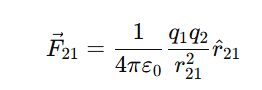
Q11. What does the unit vector r^2
Q12. How does Coulomb’s law explain attraction and repulsion?
Answer:
- Like charges → force along r12→ repulsion
- Unlike charges → force along −r21 → attraction
Q13. Does Coulomb’s law depend on the sign of charges?
Answer:
No. The same equation applies to both like and unlike charges. The direction of force changes automatically.
Q14. How does Coulomb’s law obey Newton’s third law?
Answer:
The force on q1 due to q2 is equal in magnitude and opposite in direction to the force on q2 due to q1 F⃗12=−F⃗21
Q15. Is Coulomb’s law valid in matter?
Answer:
Coulomb’s law is strictly valid in vacuum. In matter, the presence of charged particles modifies the force.
Q16. At what scale is Coulomb’s law valid?
Answer:
Coulomb’s law is valid from macroscopic scale down to subatomic scale (≈ 10−10m).
Q17. Why is coulomb considered a very large unit of charge?
Answer:
Because two charges of 1 C placed 1 m apart exert a very large force: F=9×10⁹ N
Q18. How can Coulomb’s law be used to define the unit of charge?
Answer:
One coulomb is defined as the charge which, when placed 1 m apart from an equal charge in vacuum, produces a force of 9×10⁹
Read Also : Electric charge and field handwritten notes