Skip to content
-
Learning Horizon
18-.207.056" />Subscribe to our newsletter & never miss our best posts. Subscribe Now!
Learning Horizon logo Learning Horizon

Learn Today, Lead Tomorrow!

Learning Horizon logo Learning Horizon

Learn Today, Lead Tomorrow!

  • Home
  • About
  • Contact
  • Privacy Policy
  • Disclaimer
  • eBooks-handwritten-notes
  • CUET 2025
    • CUET 2025 SYLLABUS
    • How to fill CUET 2025 form ?
  • Topic मंथन
  • YOUTUBE CONTENTS
  • EDUCATIONAL BLOGS
    • Maglev Technology क्या है? | Magnetic Levitation Train की पूरी जानकारी
    • JEE Main 2026 Exam Strategy: First 30 Minutes Plan for 100+ Score
    • BEST ENGINEERING COLLEGE IN INDIA
    • BEST MEDICAL COLLEGE IN INDIA
    • Nalanda University: History, Facts, Courses & UNESCO World Heritage Site 2025
    • Skill India Mission 2026 – Free Skill Courses, Certificate & Job Opportunities
    • Top Government Polytechnic Colleges in Uttar Pradesh
    • ARTIFICIAL PHOTOSYNTHESIS 1
    • The role of AI in education- ARTIFICIAL INTELLIGENCE EDUCATION 2025,AI
    • Nalanda University: History, Facts, Courses & UNESCO World Heritage Site 2025
    • Global Initiatives : AI education , future scope 2025
    • Indian Institutes of Management (IIMs) in India :Establishment year, popular courses, approximate fees, and admission process 2025
    • Kaynes Technology India Ltd (KAYNES) – Share Price Today, Results & News
    • PSI Exams USA 2025 : Real Estate, Insurance, Cosmetology & Contractor Tests
    • Indus Valley Civilization 2600 and 1900 BCE best notes
  • GEOGRAPHY
    • भारत – आकार और स्थिति (India – Size and Location): CHAPTER 1
  • Class 11th
    • Class 11 NCERT Exemplar Books PDF – Chapter-Wise Solutions for Physics, Chemistry & Maths
    • Class 11 Physics Important Numerical- Chapter Wise NCERT Based Problems with Answers
    • Class 11 Physics All Derivations – Chapter-Wise Important Formulas (PDF)
    • Class 11 Physics Previous Year Questions :PDF with Solutions
    • Class 11 NCERT Exemplar Books PDF – Chapter-Wise Solutions for Physics, Chemistry & Maths
  • Class 12th
    • Class 12 hand written physics notes best content
    • Matrices and Determinants Notes PDF – JEE Main, CUET & top Other Exams 2026
    • Class 12th Syllabus 2025-26 – Detailed Subject-Wise Curriculum (CBSE)
    • Class 12 Chemistry Handwritten Notes PDF | best notes
    • Class 12 Chemistry Handwritten Notes PDF | Aldehyde Ketone Carboxylic Acid & Amine
    • Class 12th Syllabus 2025-26 – Detailed Subject-Wise Curriculum (CBSE)
  • Class 10th
    • Best Class 10 Economics Notes PDF | Chapter-wise Summary, Definitions & Diagrams
    • Class 10th Social Science Notes PDF Download – Chapter Wise NCERT Notes 2025-26
  • Class 11 NCERT Exemplar Books PDF – Chapter-Wise Solutions for Physics, Chemistry & Maths
  • Class 9th
    • SCIENCE IMPORTANT POST
      • SCIENCE CLASS 9TH
  • Class 9 Important Differences: Science, Social Science & Maths Explained
  • TEST SERIES ( TARGET BOARD SERIES 2024-25)
  • हिंदी व्याकरण
    • 1. विराम चिन्ह
    • संज्ञा
    • सर्वनाम
    • विशेषण
    • संधि
    • पर्यायवाची शब्द 2
    • मुहावरे -5
  • ENGLISH GRAMMER
    • NOUN
    • PRONOUN
  • HANDWRITTEN NOTES
    • CLASS 11TH BIOLOGY NOTES
  • Competitive Exam
    • UPSC
    • Railway
      • प्रमुख वैश्विक सूचकांकों में भारत की स्थिति (2024) : most important ranking
      • Most Important Computer GK : for NTPC, RRB, Group D & SSC Exams 2025
      • गांधी युग की सम्पूर्ण जानकारी | SSC / NTPC Modern History BEST Notes in Hindi 2025
    • SSC CGL
      • SSC CGL 2025 | Notification, Exam Dates, Syllabus & Latest Updates
      • Probability NTPC / SSC CGL
    • State Exam
  • Current affairs
  • SAMPLE PAPER 2025-26
    • CBSE sample paper 2025-26 class 10 : class 12
    • Bihar Board Model Paper 2026 | class 10th and 12th Official BSEB PDF
    • UPMSP Model Paper 2025-26 PDF | class 10 and 12
  • Bihar Board Special
    • MATHS CLASS X
    • SCIENCE CLASS X
    • SST
    • HINDI GRAMMAR CLASS X
  • Up Board Special
  • Jharkhand Board Special
Close

Search

  • https://www.facebook.com/
  • https://twitter.com/
  • https://t.me/
  • https://www.instagram.com/
  • https://youtube.com/
Subscribe
NCERT Solutions for Class 11 Physics
NOTES

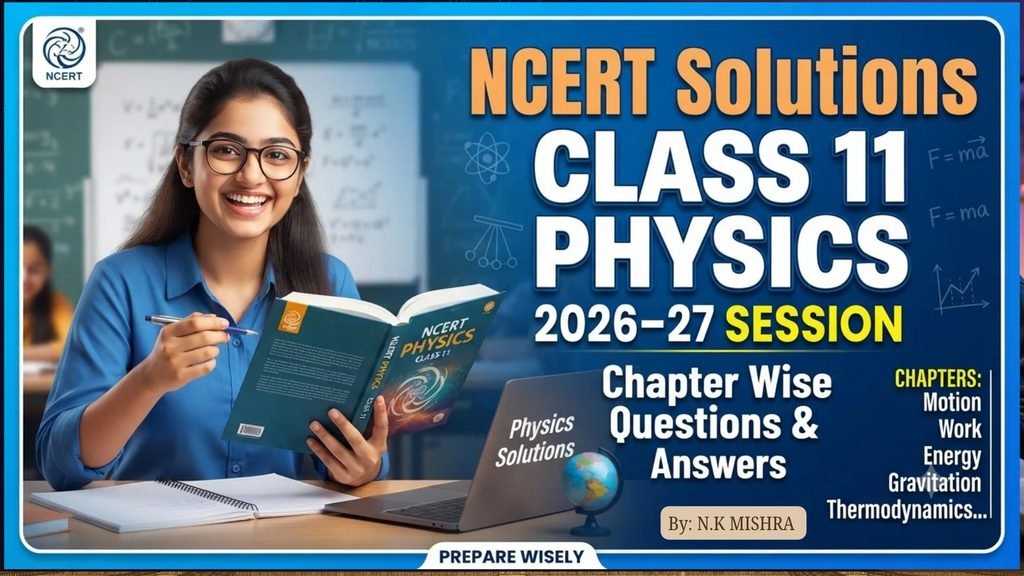
NCERT Solutions for Class 11 Physics 2026–27 | Chapter Wise Questions &BEST Answers

By Learning Horizon
November 28, 2026 7 Min Read
Comments Off on NCERT Solutions for Class 11 Physics 2026–27 | Chapter Wise Questions &BEST Answers
NCERT Solutions for Class 11 Physics

NCERT Solutions for Class 11 Physics 2026–27 | Chapter Wise Questions & Answers

NCERT Solutions for Class 11 Physics 2026–27 | Chapter Wise Questions & Answers

NCERT Solutions for Class 11 Physics 2026–27

Prepare smarter and achieve excellent results with NCERT Solutions for Class 11 Physics 2026–27. Get comprehensive, accurate, and easy-to-understand chapter-wise solutions based on the latest NCERT syllabus. These expertly explained answers cover all textbook exercises, important numerical problems, conceptual questions, and intext questions to strengthen your Physics fundamentals.

At Learning Horizon, students can access step-by-step solutions, important formulas, detailed numerical explanations, and exam-oriented question answers in both Hindi and English. Whether you are preparing for school examinations, building strong concepts, or revising important topics, these complete NCERT Class 11 Physics Solutions will make your learning journey easier, smarter, and more effective.

Explore all chapters, practise important questions, understand complex concepts, and boost your confidence in Physics with Learning Horizon.

Class 12 Physics – Chapter 1: Electric Charges and Fields
Complete NCERT-Based Notes 2026–27

Chapter Contents

  1. Introduction
  2. Electric Charge
  3. Conductors and Insulators
  4. Basic Properties of Electric Charge
    • Additivity of Charges
    • Conservation of Charge
    • Quantisation of Charge

1.1 Introduction

We often observe sparks or hear crackling sounds when removing synthetic clothes or sweaters, especially during dry weather.

Other common examples of static electricity include:

  • Lightning during thunderstorms.
  • Electric shocks while touching a car door after sliding across a seat.
  • Attraction of small pieces of paper by a rubbed plastic comb.
  • Sparks produced when certain insulating materials are rubbed together.

These phenomena occur due to the accumulation and discharge of electric charges.

Static Electricity: Static electricity refers to electric charges accumulated on the surface of objects that remain stationary.

Electrostatics: The branch of physics that deals with the study of forces, electric fields and electric potentials arising from stationary electric charges is called electrostatics.

Important Point: Static means something that does not move or change with time.

1.2 Electric Charge

Definition: Electric charge is a fundamental property of matter due to which a body experiences an electric force when placed in the presence of another charged body.

  • Symbol: \(q\) or \(Q\)
  • SI Unit: Coulomb (C)
  • Nature: Scalar quantity
  • Types: Positive and Negative

1.2.1 Historical Background

  • Around 600 BC, Thales of Miletus, Greece, observed that amber rubbed with wool or silk attracts light objects.
  • The word electricity is derived from the Greek word Elektron, meaning amber.
  • Benjamin Franklin introduced the terms positive and negative charges.

1.2.2 Types of Electric Charges

There are two types of electric charges:

1. Positive Charge (+)

A body becomes positively charged when it loses electrons.

2. Negative Charge (−)

A body becomes negatively charged when it gains electrons.

Laws of Attraction and Repulsion

The interaction between electric charges follows two fundamental rules:

  1. Like charges repel each other.
  2. Unlike charges attract each other.
CombinationInteraction
Positive (+) and Positive (+)Repulsion
Negative (−) and Negative (−)Repulsion
Positive (+) and Negative (−)Attraction

Important Concept

Like Charges Repel and Unlike Charges Attract.

The property that distinguishes the two types of charges is called the polarity of charge.

1.2.3 Charging by Rubbing

When two different insulating materials are rubbed together, electrons may transfer from one material to another.

Example: Glass Rod Rubbed with Silk

  • Some electrons move from the glass rod to the silk.
  • The glass rod loses electrons and becomes positively charged.
  • The silk gains electrons and becomes negatively charged.
MaterialCharge
Glass RodPositive (+)
Silk ClothNegative (−)

Important Points:

  • Electrons are transferred during rubbing.
  • Protons do not normally transfer between solid objects in this process.
  • No new electric charge is created.
  • The total electric charge remains conserved.

1.2.4 Gold Leaf Electroscope

Definition: A gold leaf electroscope is an instrument used to detect the presence of electric charge on a body.

Main Parts

  1. Metal Knob
  2. Vertical Metal Rod
  3. Two Thin Gold Leaves
  4. Protective Glass Case

Working Principle

When a charged object touches the metal knob, electric charge flows through the metal rod to the gold leaves.

Both leaves acquire the same type of charge and repel each other. As a result, the leaves diverge.

Important Point: The degree of divergence of the leaves indicates the amount of charge qualitatively.

NCERT Solutions for Class 11 Physics 2026–27 | Chapter Wise Questions & Answers

1.3 Conductors and Insulators

Materials are classified according to their ability to allow electric charges to move through them.

1.3.1 Conductors

Definition: Materials that allow electric charges to move through them easily are called conductors.

Examples:

  • Copper
  • Silver
  • Aluminium
  • Iron
  • Human body
  • Earth

Characteristics of Conductors

  1. They contain electric charges, particularly electrons, that are comparatively free to move.
  2. Electric charges can move easily inside them.
  3. When charge is transferred to a conductor, it readily gets distributed over its surface.

1.3.2 Insulators

Definition: Materials that do not allow electric charges to move through them easily are called insulators.

Examples:

  • Glass
  • Porcelain
  • Plastic
  • Nylon
  • Wood
  • Rubber

Characteristics of Insulators

  1. Their electrons are tightly bound to atoms.
  2. Electric charges cannot move freely through them.
  3. Charge deposited on an insulator tends to remain near the same location.

1.3.3 Semiconductors

Definition: Materials whose electrical resistance to the movement of charges is intermediate between conductors and insulators are called semiconductors.

Examples:

  • Silicon
  • Germanium

Difference Between Conductors, Insulators and Semiconductors

PropertyConductorsInsulatorsSemiconductors
Charge movementEasyDifficultIntermediate
Free electronsComparatively manyVery fewLimited
Electrical conductionHighVery lowIntermediate
ExamplesCopper, SilverGlass, PlasticSilicon, Germanium
Why Does a Plastic Comb Become Charged but a Metal Spoon Usually Does Not?

A plastic comb becomes charged when rubbed with dry hair because it is an insulator, and the charge remains on it.

However, when a metal spoon is held in the hand, the charge can flow through the conducting body to the ground. Therefore, the spoon usually does not retain the charge.

1.4 Basic Properties of Electric Charge

Electric charge possesses three fundamental properties:

  1. Additivity of Charges
  2. Conservation of Charge
  3. Quantisation of Charge

Before studying these properties, we should understand the concept of a point charge.

Point Charge

Definition: If the size of a charged body is very small compared with the distance between the charged bodies, its entire charge can be assumed to be concentrated at a single point. Such a charge is called a point charge.

1.4.1 Additivity of Charges

Definition: The total electric charge of a system is equal to the algebraic sum of all individual charges present in that system.

Mathematical Expression

For two charges:

[ Q=q1+q2 ]

For \(n\) charges:

[Q=q1+q2+q3+………..+qn} \]

Where:

  • (Q) = Total charge
  • q1,q2,q3 = Individual charges
  • (n) = Number of charges

Example 1: Calculation of Total Charge

Question: A system contains five charges:(+1C,+2C,-3C,+4C) and (-5C). Calculate the total charge of the system.

Solution:

Given:

Answer: −1 C

Important Points
  • Electric charge is a scalar quantity.
  • Charges are added algebraically.
  • Proper signs (+ or −) must be used.
  • Unlike mass, electric charge can be positive or negative.

1.4.2 Conservation of Charge

Definition: The total electric charge of an isolated system always remains constant, irrespective of the physical processes occurring within the system. This is known as the law of conservation of electric charge.

Mathematical Expression

Explanation with Example

When a glass rod is rubbed with silk:

  • The glass rod loses electrons and becomes positively charged.
  • The silk gains electrons and becomes negatively charged.

Suppose the glass rod acquires (+5C) and the silk acquires (-5C).

Total charge:

Thus, the total charge before and after rubbing remains unchanged.

Important Points

  1. Electric charge can neither be created nor destroyed.
  2. Charge can only be transferred from one body to another.
  3. The total charge of an isolated system remains constant.
  4. Charge may be redistributed among different bodies without changing the total charge.

1.4.3 Quantisation of Charge

Definition: The electric charge on a body always exists as an integral multiple of the elementary charge. This property is known as quantisation of electric charge.

Mathematical Expression

q=ne

Formula for Quantisation of Charge

Where:

  • \(q\) = Total charge on the body
  • \(n\) = Any integer (positive, negative or zero)
  • \(e\) = Elementary charge

e=1.602*10-19 C

Charge on Electron and Proton

ParticleCharge
Electron-1.602*10-19 C
Proton+1.602*10-19 C
Neutron0

Example 2: Calculation Based on Quantisation of Charge

Question: A body carries a charge of \(+3.2\times10^{-19}C\). Calculate the number of elementary charges corresponding to this charge.

Solution:

Answer: The body carries a net charge equal to two positive elementary charges.

Important Scientific Contributions

  • Michael Faraday suggested the quantisation of charge through his experimental laws of electrolysis.
  • Robert Millikan experimentally demonstrated the quantisation of electric charge in 1912.

1.4.4 SI Unit of Electric Charge

The SI unit of electric charge is Coulomb, represented by the symbol C.

One coulomb is the amount of charge flowing through a wire in one second when the electric current is one ampere.

Q=It

Where:

  • \(Q\) = Electric charge
  • \(I\) = Electric current
  • \(t\) = Time

Relation Between Coulomb and Elementary Charge

1C= 6.25*1018e

Thus, one coulomb is approximately equal to the magnitude of the charge of \(6.25\times10^{18}\) electrons.

Smaller Units of Electric Charge
UnitSymbolValue
CoulombC1C
MillicoulombmC10-3C
Microcoulombmicro C10-6C
NanocoulombnC10-9C

1.4.5 Continuous and Discrete Nature of Charge

At the microscopic level, electric charge exists in discrete units of elementary charge.

However, at the macroscopic level, the elementary charge is extremely small. Therefore, a large collection of elementary charges appears to behave like a continuous distribution.

Example: A dotted line appears continuous when viewed from a distance, although it is actually made up of separate dots.

Similarly, a large collection of tiny electric charges may appear continuous.
Author

Learning Horizon

Follow Me
Other Articles
science 9
Previous

Class 9 Science Practice Paper 2026–27 | top Important Questions & Answers

NCERT 2026-27
Next

NCERT Solution class 11 physics 2026-27: chapter wise solution

PREMIUM NOTES 2026–27

Class 12 Physics Notes PDF

NCERT Based Complete Notes
Hindi + English Medium

✅ Chapter-wise Detailed Theory

✅ Important Formulas & Derivations

✅ Solved Numericals

✅ Important MCQs with Answers

✅ 2, 3 & 5 Marks Questions

✅ Important Diagrams

✅ Board Exam Practice

Chapter 1: Electric Charges and Fields
₹99 ₹49 50% OFF
🛒 BUY NOW @ ₹49
🔒 Secure Payment via Razorpay
LEARNING HORIZON
LEARNING HORIZON
BSEB BOARD EXAM 2026-27
📚

CLASS 10 HISTORY

COMPLETE PREMIUM NOTES

SPECIAL OFFER
₹129 ₹59
LIMITED PRICE OFFER
BUY NOW – ₹59 →
LEARNING HORIZON CLASS 10 SST
▶
Class 12 Science Lectures JAC Board • All Subjects
JAC Class 12 Physics Lecture ▶
Class 12 Physics Important Questions Chapter-wise Revision
Class 12 Physics PYQ ▶
Physics PYQ Practice Board Exam Preparation
JAC Class 12 Chemistry Lecture ▶
Class 12 Chemistry Important Questions Chapter-wise Revision
Class 12 Chemistry PYQ ▶
Chemistry PYQ Practice Important Board Questions
JAC Class 12 Biology Lecture ▶
Class 12 Biology Important Questions Chapter-wise Revision
Class 12 Biology PYQ ▶
Biology PYQ Practice Board Exam Preparation
▶
Chapter-wise Revision
JAC Class 12 Maths PYQ ▶
Maths PYQ Practice Important Board Questions
JAC Class 12 English Lecture ▶
Class 12 English Important Questions Literature & Grammar
JAC Class 12 English Revision ▶
English Board Exam Revision Important Questions
▶ View All Class 12 Lectures
▶
Class 10 Video Lectures All Subjects • JAC Board
Class 10 Maths Lecture ▶
Class 10 Maths Important Questions Chapter-wise Revision
Class 10 Maths PYQ ▶
Class 10 Maths PYQ Practice Previous Year Questions
Class 10 Science Lecture ▶
Class 10 Science Important Questions Important Topics & PYQs
Class 10 Science Revision ▶
Science Chapter-wise Revision Board Exam Preparation
Class 10 Social Science Lecture ▶
Class 10 Social Science History • Geography • Civics
Class 10 Hindi Lecture ▶
Class 10 Hindi Important Questions Literature & Grammar
Class 10 English Lecture ▶
Class 10 English Important Questions Literature & Grammar
Class 10 Sanskrit Lecture ▶
Class 10 Sanskrit Revision Important Questions
▶ View All Class 10 Lectures
▶
Class 12 Arts Lectures JAC Board • All Subjects
JAC Class 12 History Lecture ▶
Class 12 History Important Questions Chapter-wise Revision
JAC Class 12 History PYQ ▶
History PYQ Practice Board Exam Preparation
JAC Class 12 Geography Lecture ▶
Class 12 Geography Important Topics Chapter-wise Revision
JAC Class 12 Geography PYQ ▶
Geography PYQ Practice Important Board Questions
JAC Class 12 Political Science Lecture ▶
Class 12 Political Science Important Questions & Revision
JAC Class 12 Economics Lecture ▶
Class 12 Economics Important Questions Chapter-wise Revision
JAC Class 12 Sociology Lecture ▶
Class 12 Sociology Important Topics Board Exam Revision
JAC Class 12 Hindi Lecture ▶
Class 12 Hindi Important Questions Literature & Grammar
JAC Class 12 English Lecture ▶
Class 12 English Important Questions Literature & Grammar
▶ View All Class 12 Arts Lectures
Copyright 2026 — Learning Horizon. All rights reserved. Blogsy WordPress Theme